
Key Takeaways
- Warmly helps B2B revenue teams identify anonymous website traffic at the person level and trigger automated sales engagement.
- Warmly requires a substantial financial commitment with annual subscriptions starting at $10,000 or quarterly deanonymization plans at $4,875.
- Warmly supports AI agent execution through its web application, REST API, and Model Context Protocol integrations under human supervision.
- Warmly is built for complex pipeline generation and may exceed the needs of teams seeking lightweight marketing automation tools.
Warmly makes most sense when your B2B team needs to turn known site activity into conversations, and can justify a starting annual spend of $10,000. It is a compelling fit for revenue teams that want person-level visitor identification, a shared account record and human-supervised agents; choose a simpler marketing platform if that is more machinery than your motion needs.
Agent access
- API
- Yes, every Warmly account, including Free: 250 credits/month. Paid tiers start at $99/month.
- MCP server
- Official, hosted, OAuth in a browser on the first tool call
- Works with
 ClaudeClaude Code
 Cursor
- Automation
- Zapier
What are the core advantages and drawbacks of Warmly?
What works
- Identifies website visitors at the person level
- Connects activity, outcomes and account context in one graph
- Runs inbound and TAM agents across several channels
What to watch
- Annual plans begin at $10,000
- GTM Signals and Warm Experiences cost $10,000 a year each
- Video Chat Agent pricing requires a sales conversation
What does Warmly do to accelerate B2B revenue pipelines?
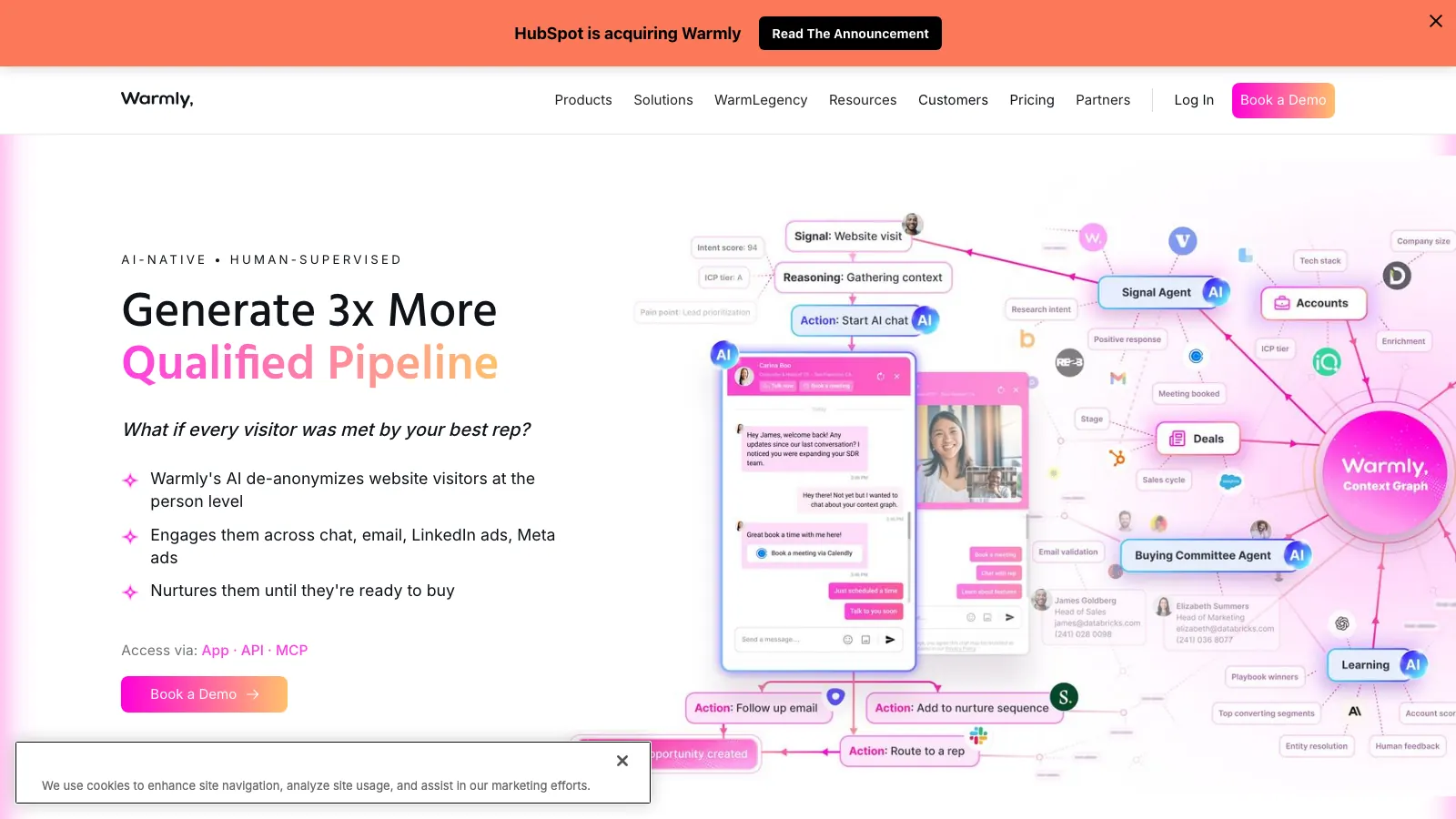
Warmly says it de-anonymizes website visitors at the person level, then engages them through chat, email, LinkedIn ads and Meta ads. That makes it a different kind of choice from the broader marketing tools directory. You are buying a system to connect buyer signals and action, not simply a place to schedule campaigns.
The central idea is the Context Graph. Warmly brings together site visits, emails, call transcripts, CRM activity, chat logs, conversions and ad engagement. It also records people, companies, deals and buying committees. The useful part is not the long list of records. It is that a rep or agent can see the thread of an account before deciding what to do next.
I would treat that shared context as Warmly's reason to exist. A team already juggling handoffs between its CRM, chat and outbound process gets a single account timeline. A team that only needs newsletters or a few simple sequences is likely to pay for context it will not use.
Who gets the most value from deploying Warmly?
B2B demand teams
Turn known website activity into routed alerts, chat and follow-up rather than waiting for another form fill.
Revenue operations
Keep site, CRM, email and call activity connected around accounts so handoffs retain their context.
Account-based teams
Use the TAM Agent to score accounts, map buying committees and coordinate email with advertising.
Agent builders
Give a human-supervised GTM workflow access through the app, API or MCP rather than another isolated dashboard.
Warmly is less convincing for a small business that has not settled its sales process, or a marketing team whose work ends with email automation. Its plans start at a level that calls for a clear owner and a real use for the account intelligence.
What visitor deanonymization and engagement tools does Warmly include?
Person-level visitor identification
Warmly says its AI de-anonymizes website visitors at the person level. Its Web-Deanonymization plan includes visitor contacts and companies, ICP filtering, real-time and Slack alerts, lead routing, CRM sync, webhook integrations, and retargeting through email, LinkedIn and ads. For a sales team, that changes the action from reviewing a traffic total to deciding who should follow up.
Context Graph
The Context Graph combines signals, actions, context and outcomes for each account. A site visit or intent signal can sit beside emails sent, ads served, call notes, meeting summaries and deal context. Warmly also surfaces account summaries, intent scores and a next-best-action view. This is the feature to examine closely in a demo, because it determines whether the product becomes a working record or another data feed.
Inbound Agent and Autopilot
Inbound Chat adds an AI chatbot with one AI Studio Agent, live chat, offers, chat metrics and automated email follow-up. AI Inbound Autopilot adds unlimited AI Studio Agents and an Autopilot Agent, along with goal-setting, qualification and decision-making, mini-demo slide generation, AI-written follow-up and chat improvement. Warmly calls the broader model human-supervised, which is the right frame for a team that still wants control over customer conversations.
TAM Agent
Warmly's TAM Agent is the outbound half of the product. It breaks a total addressable market into scored accounts, maps buying committees, tracks signals across channels and runs coordinated email and ads. Its Context Graph can also hold intent signals, funding news, job changes and competitive research beside the interactions your team creates. That is a stronger proposition for account-based work than a generic contact list.
Integrations and machine access
Warmly lists access through its app, API and MCP. Its integration page names CRM, notification, marketing automation, advertising and email connections, including Slack alerts and webhook support. The practical question is whether those connections preserve the account context your team needs. Make that a requirement in the sales conversation, rather than assuming every integration behaves the same way.
How is Warmly priced for enterprise and mid-market teams?
Price checked 27 Nov 2026
| Plan detail | Web-Deanonymization$10,000/yr | Inbound Chat$20,000/yr | AI Inbound Autopilot$30,000/yr |
|---|---|---|---|
| Credits | From 10K/mo | From 10K/mo | From 10K/mo |
| Visitor identification and routing | ✓ | ✓ | ✓ |
| CRM sync and retargeting | ✓ | ✓ | ✓ |
| AI chatbot and follow-up | Not listed | One AI Studio Agent | Unlimited AI Studio Agents |
| Autopilot Agent | Not listed | Not listed | ✓ |
Warmly plans, 27 Nov 2026.Warmly pricing
“Not listed” describes the published plan inclusions. It does not rule out optional availability.
Quarterly billing is published at $4,875, $6,500 and $9,750 respectively. Annual billing is presented as a 30% saving. The table shows starting prices, so your team should confirm credit volume and any implementation scope before treating either number as the full bill.
Add-ons can change the budget quickly:
- GTM Signals Package: $10,000 a year
- Warm Experiences: $10,000 a year
- AI 24/7 Video Chat Agent: contact sales for pricing
For a team choosing annual Web-Deanonymization plus both published $10,000 add-ons, the published starting commitment is $30,000 a year before any separately quoted work. That is why I would price Warmly as a coordinated GTM investment, not a low-cost visitor alert.
Where does Warmly fall short for smaller marketing teams?
Warmly's first limitation is cost. The annual entry product starts at $10,000, and the agent-led Autopilot starts at $30,000. Quarterly billing gives a shorter commitment, but it is still a product for a team that has agreed what it will do with identified visitors, alerts and account signals.
The product range also asks you to choose the level of automation carefully. Inbound Chat includes one AI Studio Agent and automated email follow-up, while Autopilot adds unlimited AI Studio Agents and the Autopilot Agent. Those are materially different operating models. Decide who owns the conversations, reviews the actions and handles the handoff before buying either.
Finally, the public plan details do not settle every budget question. The Video Chat Agent is quoted through sales, and the plans give starting credit volumes rather than a universal team bill. Get those operational details in writing before making Warmly the center of your campaign workflow.
What are the top alternatives to Warmly for revenue teams?
 Warmly competitors include AI Peekaboo, which serves teams focused primarily on monitoring brand recommendations inside generative AI answers. Warmly is built around visitor identity and GTM engagement instead, so these tools solve different problems and can sit in different parts of a stack.
 Woodpecker review is the better next read when outbound email is the immediate decision. Its Email plan is based on emails sent and includes unlimited team members and email accounts, a clearer fit when you need to scale an email team rather than build account intelligence around site activity.
 ActiveCampaign review is useful when your priority is email generation shaped by your existing campaigns: ActiveCampaign says its next email reflects your brand and voice, modeled on your best campaigns. Warmly also lists an ActiveCampaign integration that can sync high-intent leads into targeted campaigns.
What is the final verdict on implementing Warmly?
Warmly is worth a serious look when your site already matters to pipeline and your team needs more than a company name or another alert. The combination of person-level visitor identification, shared account context and human-supervised agents gives a revenue team a coherent operating model. The price makes sense only when someone is ready to own that model.
Start by defining the handoff from visitor signal to rep or agent action. Then compare the $10,000 starting plan with the quarterly option, confirm credit needs and integrations, and add automation only where your team can review the outcome.
How was this Warmly review researched and verified?
Warmly pricing terms, plan limits, and Context Graph features were validated directly against official company pages on 27 Nov 2026. Prices use the dollar amounts displayed by Warmly, and every figure follows how we check figures.
- Warmly pricing pages for annual and quarterly billing
- Warmly pages for the Context Graph, Inbound Agent and TAM Agent
- Warmly integration and website pages
What are the most common questions asked about Warmly?
What does Warmly identify?
Warmly says it de-anonymizes website visitors at the person level. Its entry plan includes website visitor contacts and companies, ICP filtering, alerts, lead routing and CRM sync.
How much does Warmly cost?
Annual Web-Deanonymization starts at $10,000, Inbound Chat at $20,000 and AI Inbound Autopilot at $30,000. Warmly also publishes quarterly prices of $4,875, $6,500 and $9,750.
Does Warmly have API and MCP access?
Yes. Warmly lists access through its app, API and MCP on its website. Confirm the endpoints and permissions you need during implementation planning.
What is Warmly's Context Graph?
It is Warmly's account data layer. It connects signals such as site visits and intent with actions, supporting context and outcomes, alongside records such as people, companies, deals and buying committees.
 Reviewed byDanny Kirk
Founder of ReddiReach.
 Checked byAndrés Felipe
Digital designer and marketer.
Every figure is checked against the vendor's own page. Read our editorial standards.