
Key Takeaways
- Chartbeat gives digital newsrooms and editorial teams real-time audience attention metrics, concurrent visitor counts, and headline testing tools.
- Chartbeat operates entirely on custom enterprise pricing quotes based on monthly web and native mobile application pageview volumes.
- Chartbeat provides a real-time data API that enables internal applications and automated editorial agents to access live reader behavior.
- Chartbeat is poorly suited for standard marketing websites needing self-serve checkout or conventional lead-generation analytics.
Chartbeat is the best fit when you run a digital newsroom and need live reader signals to shape the publishing day. Choose another analytics product if your work is not editorial publishing, or if a public, self-serve price is essential before you speak with sales.
Agent access
- API
- Yes, all customer plans for the Real-Time API
- MCP server
- Not found on official pages
What are the primary strengths and limitations of Chartbeat?
What works
- Live dashboards show traffic, engagement and referrals
- Engaged time, scroll depth and recirculation add context
- Testing, benchmarking and advanced analysis can be added
What to watch
- No public price for any of the four tiers
- Every paid route starts with a sales conversation
- The product is designed around digital-publishing workflows
How does Chartbeat assist digital newsrooms with real-time editorial decisions?
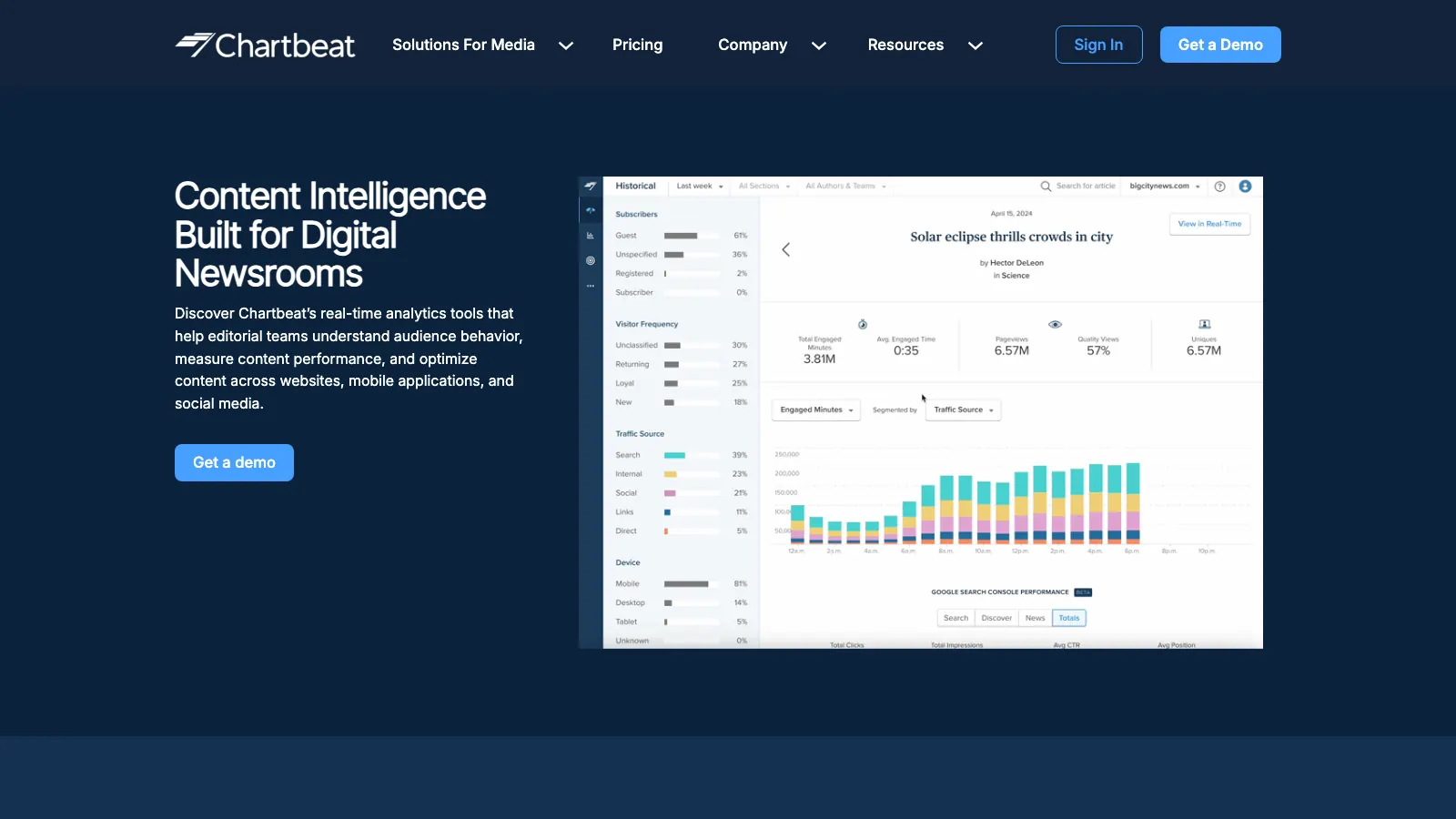
Chartbeat delivers immediate audience data during breaking news stories so editorial teams do not wait for lagged monthly reports. Chartbeat centers that moment. Its Real-Time Dashboard follows pages across your sites, showing what drives traffic and reader engagement, while its alerts flag unusual spikes and dips. The marketing tools directory is broad, but Chartbeat's job is unusually specific: helping editorial teams act on audience behavior while the publishing day is still in motion.
That focus extends beyond a live board. Chartbeat records engaged time, scroll depth and recirculation, while its Historical Dashboard gives teams 13 months of trends for engagement, traffic and topic-based data. In my view, that is a more coherent package for an editorial desk than a general dashboard with every possible marketing metric. It is built around stories, placement and the reader journey, not a generic funnel.
The tradeoff is commercial clarity. Chartbeat says its price scales with website and native-app pageviews, and asks buyers to speak with its team for the right plan. You can know the product structure before a call, but not the bill. If you need procurement to compare software from a published rate card, that gap may end the evaluation early.
Which media organizations and news publishing teams gain the most from Chartbeat?
News editors
Use live audience signals to decide story placement and homepage attention.
Audience teams
Track engaged time, scroll depth and recirculation across daily publishing decisions.
Editorial analysts
Explore historical trends and export content-performance data for deeper analysis across teams.
Publisher product teams
Connect reader behavior with recommendations, testing and conversion-focused tools for product decisions.
I would put Chartbeat on the list only when publishing content is central to the business. Its own positioning is for digital publishers, editorial teams and enterprise media organizations. A company looking for a catch-all marketing analytics platform would be buying an editorial specialist, then paying for a sales-led package whose fit is harder to justify.
What engaged-time tracking and headline testing features does Chartbeat provide?
Real-time dashboard and alerts
The Real-Time Dashboard tracks every page across your sites so you can see traffic sources and engagement in the moment. It surfaces concurrent pageviews, unique visitors and recirculation, while the Heads Up Display adds ranked story performance, scroll depth and placement context. Real-Time Alerts notify teams about unusual traffic rises and drops. That combination makes sense for a desk that needs a decision signal now, not a retrospective chart tomorrow.
Engaged time and historical reporting
Chartbeat measures engaged time, including scroll depth and recirculation. Its Historical Dashboard holds 13 months of trends in engaged time, website traffic and topic-based data. Analytics Pro's Data Lab can analyze up to 24 months for longer investigations and comparisons. The distinction matters because it lets editors look at how readers interact with a piece as well as whether they opened it. Reports can be customized, scheduled and exported, which is enough structure for an editorial leader who wants recurring performance conversations rather than another manual data pull.
Headline and image testing
The Testing performance suite lets editorial teams run reader-tested headlines and images on their homepages. Headline Testing uses a dynamic algorithm to track and serve the best-performing headline during a test, while Image Testing can run A/B tests for up to ten homepage images. Chartbeat also offers AI-generated headline suggestions based on past successful headlines. That is useful when a homepage decision affects a story's chance of being read, although the suite is not included in every tier.
Benchmarking and audience recommendations
With Chartbeat Cohorts, a publisher can compare its performance with other digital publishers in Chartbeat's global network. The Benchmarking suite also includes Tubular Viewpoint for social-video strategy. On the reader side, the Reader Experience suite includes Recommendations, which uses audience behavior to suggest content, plus Conversions data for article-level financial impact. These are purposeful additions for a publisher, not generic extras padded onto an analytics package.
API and advanced analysis
Chartbeat's Essentials tools include real-time APIs for custom experiences and sending reader analytics into internal tools, plus historical API access through Advanced Queries. Analytics Pro adds Datastream for integration into an existing data ecosystem and Data Lab for custom dashboards and visualizations inside Chartbeat. For a data team, that makes the plan question about advanced delivery and analysis, not whether ordinary API access exists.
How does Chartbeat structure its quote-based enterprise pricing plans?
Price checked 27 Nov 2026
| Plan detail | EssentialsQuote | PlusQuote | PremiumQuote | EnterpriseQuote |
|---|---|---|---|---|
| Pricing basis | Website and app pageviews | Website and app pageviews | Website and app pageviews | Website and app pageviews |
| Real-time and historical reporting | ✓ | ✓ | ✓ | ✓ |
| Performance suites | Not included | Choose 1 | Choose 3 | All included |
| Unlimited seats | ✓ | ✓ | ✓ | ✓ |
| Single sign-on | Not listed | Not listed | Not listed | ✓ |
Chartbeat plans, 27 Nov 2026.Chartbeat pricing
Chartbeat quotes team pricing based on website and native-app pageviews. The sales proposal should name your website and app pageview volume, the tier, and the performance suites. On Plus, choose one of Reader Experience, Testing, Benchmarking or Analytics Pro. Premium includes three choices. Enterprise includes all four and single sign-on.
What advanced features and service terms come with Chartbeat Enterprise?
Chartbeat Enterprise delivers the complete package of real-time publishing analytics, integrations, and enterprise service terms. It keeps the Essentials foundation, includes every performance suite and adds single sign-on. That means headline and image testing, benchmarking, Reader Experience and Analytics Pro arrive together rather than being selected one at a time. For a large publisher, that is simpler to govern. For a smaller team, it may mean paying for more capability than the editorial workflow needs, which is why the quote should separate the suite question from the pageview question.
Where does Chartbeat create procurement hurdles for smaller teams?
Chartbeat introduces procurement friction due to its lack of public pricing and required sales interactions. A buyer cannot compare four published monthly numbers or estimate a multi-site bill from the product page. The vendor tells you that pageviews set the price, but the amount stays behind a sales call. That may be a normal enterprise buying process, but it makes an early budget decision slower.
The other limitation is fit. Chartbeat is purpose-built for digital publishers and editorial teams, so its strongest capabilities speak in newsroom language: pages, stories, homepage placement, headlines and reader loyalty. That is a strength for the right team. It also means Chartbeat should earn its place by changing editorial decisions, not simply by duplicating a broad analytics view.
Finally, not every named capability comes with every plan. Testing, Benchmarking, Reader Experience and Analytics Pro are performance suites. A Plus plan has one suite and Premium has three, so ask for the exact suite in writing before treating testing, benchmarking or advanced delivery and analysis as part of the deal.
Which analytics and audience intelligence platforms compete with Chartbeat?
 AI Peekaboo review is worth reading first when the question is how your brand appears in AI answers rather than how readers behave on a publishing site. Its monthly-billing minimum is $30 a month, checked 27 Nov 2026, and it includes an API and MCP, a different buying model from Chartbeat's pageview-based quote.
If your analytics decision is about marketing attribution rather than a newsroom's editorial workflow, use the  Cometly review as a separate comparison point. Cometly connects ad spend to pipeline and revenue, while Chartbeat's published offer is content intelligence for digital publishers.
The  Factors.ai review is useful when the team needs account-conversion insights and Scout agents to make those insights actionable. Keep the comparison grounded in the job: Chartbeat's documented plans bundle real-time content performance, editorial reporting and publisher-oriented suites.
Is Chartbeat the premier real-time analytics suite for news publishing?
Chartbeat makes the most sense when your team has to decide what to do with a story while it is still live. The combination of real-time reporting, engaged-time signals, headline testing and peer benchmarking is a clear editorial package, and the four-tier structure gives a publisher a route from core reporting to an all-suite Enterprise setup.
I would not force that package onto a non-publishing team. The product's specialization is its value, but only for a newsroom or media organization that can act on the signals it produces. The lack of public pricing should be resolved before anyone invests much time in an evaluation.
Ask Chartbeat for a proposal that states your pageview basis, tier and named performance suites. Start with the editorial decision you need to improve, then buy only the suite that supports it.
How were Chartbeat analytics capabilities and API specifications validated?
Chartbeat product documentation, testing guides, and pricing pages were verified on 27 Nov 2026. Pricing is quote-only and based on website and native-app pageviews. Our how we check figures explains the standard we apply to published numbers and plan terms.
- Chartbeat pricing and plan page
- Chartbeat analytics and reporting page
- Chartbeat testing and optimization page
- Chartbeat home and company pages
What are common technical questions about deploying Chartbeat tracking scripts?
How much does Chartbeat cost?
Chartbeat does not publish plan amounts. It says pricing is based on website and native-app pageviews, and asks buyers to speak with its team for the appropriate plan.
Which Chartbeat plan includes headline testing?
Headline and Image Testing are in the Testing performance suite. Plus can include one chosen suite, Premium can include three, and Enterprise includes all performance suites.
Does Chartbeat have an API?
Yes. Chartbeat documents real-time APIs for custom experiences and for sending reader analytics into internal tools. Analytics Pro includes Datastream for deeper integration.
How much historical data does Chartbeat show?
Chartbeat's Historical Dashboard measures 13 months of trends in engaged time, website traffic and topic-based data. Analytics Pro's Data Lab can analyze up to 24 months for longer investigations and comparisons.
 Reviewed byDanny Kirk
Founder of ReddiReach.
 Checked byAndrés Felipe
Digital designer and marketer.
Every figure is checked against the vendor's own page. Read our editorial standards.