
Key Takeaways
- Directus provides an intuitive visual content workspace overlaid directly on relational SQL databases, maintaining unified data governance across humans and software agents.
- Directus offers a self-hosted Core edition at zero cost for engineering teams seeking full control over their infrastructure and database.
- Directus delivers fully managed cloud hosting starting at eighty-nine dollars monthly on annual commitments or ninety-nine dollars monthly for three seats.
- Directus includes a native Model Context Protocol server that applies identical role-based access permissions and authorization policies to human and artificial users.
Directus is the right CMS for a team that needs a visual workspace on top of its own database, while still giving applications and agents governed access to the same data. Choose a visual site builder instead if your first job is designing pages rather than shaping structured data, or if your team does not want to own the database and permissions decisions.
Agent access
- API
- Yes
- MCP server
- Official, hosted or local, OAuth or a static access token
- Works with
 ClaudeClaude Code
 ChatGPT
 Cursor
 VS Code
- Automation
- Zapier, n8n
What are the major Directus pros and cons?
What works
- Visual data modeling without SQL
- REST, GraphQL and native MCP access
- Self-hosted and cloud deployment choices
What to watch
- Core allows only three user seats
- Cloud hosting changes the monthly bill
- Grant eligibility has revenue and employee limits
What does Directus do for content and database teams?
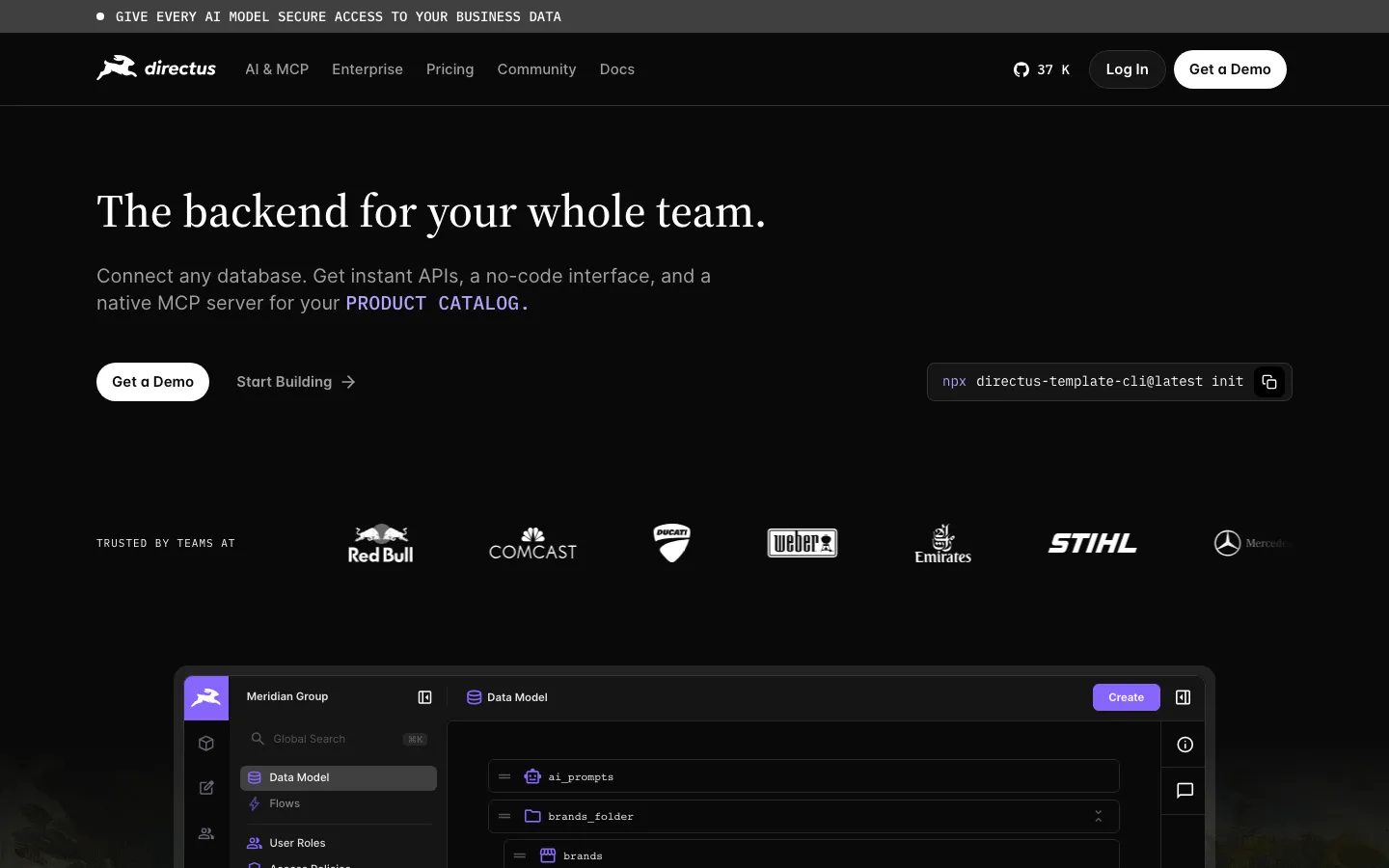
Directus turns a connected database into a workspace where content, product and operations teams can manage structured records without asking an engineer for every change. It creates APIs for that same data, so the website, app and internal tools can work from one source rather than copies in several systems. That makes it a useful stop in the marketing tools directory for a team whose content is tied to products, customers, locations or other operational data.
The important distinction is that Directus is a backend and data platform with a CMS interface, not a page-first website builder. Its Studio gives authorized people a no-code interface, while the underlying database remains central. I would choose it when that shared data model is the point of the project, not simply because a team needs to publish a few landing pages.
It also gives you a deployment decision early. Directus can run on your own infrastructure or on Directus Cloud. Cloud Core is $89 a month on annual billing, or $99 month to month, whereas self-hosted Core is $0. The lower software price does not make the hosting choice disappear, it makes the team responsible for deciding which operating model fits.
Who is Directus best built for?
Product and platform teams
Connect an existing SQL database to generated APIs and one visual workspace for shared records.
Structured content teams
Manage fields, relations and reusable content while keeping preview and version controls close at hand.
Teams using AI agents
Give MCP-compatible tools governed access through the same role-based access controls used by people.
Eligible small organizations
Assess the Open Innovation Grant with annual revenue under $5 million and fewer than 50 employees.
Directus is less compelling when the team mainly wants a visual canvas for creating a site. In that case, review a page-first tool before committing to a database-centered setup. It is also a poor fit for a buyer who needs the product to decide the data structure and access rules on their behalf.
Which data management features does Directus provide?
Visual data modeling
Directus lets users create and modify data models in a visual interface without SQL. The feature matters because a non-technical colleague can work with a collection and its fields without writing a database query, while a technical team still has a structured model to build against. The better the model matches the records people actually need to manage, the more useful that interface becomes.
APIs for applications
Directus lists REST and GraphQL APIs, plus an OpenAPI specification and SDK. It can sit over an existing SQL database, which is valuable when the data already has a home and an application needs a predictable way to read or update it. This is a stronger reason to choose Directus than a generic content editor: the API and the visual interface point at the same records.
Native MCP and access control
Directus includes a native MCP server and says agents are governed by the same role-based access control as the team. Its site names Claude Desktop, Cursor, ChatGPT and other MCP-compatible tools as connection options. That makes Directus relevant when an agent needs to work with live business data, but the permission model deserves the same care as it would for a new human role.
Editorial controls and media
Editors can preview changes beside content before publishing, and Directus lists content versioning and revision history for comparing and restoring earlier versions. The Studio also includes a file library with folders, image focal points and on-demand image transformations. Those are practical CMS controls, not an afterthought bolted onto an API layer.
Permissions and automation
Directus lists granular permissions, policy-based user management and visual workflow automation. Its Flows feature is limited by plan, so it is worth mapping the approvals and automations that matter before selecting a tier. Core includes five flows, Team includes 20, and Enterprise lists unlimited flows.
How is Directus pricing structured for cloud and self-hosted?
Price checked 27 Nov 2026
| Plan detail | Core$89/mo | Team$588/mo | EnterpriseCustom |
|---|---|---|---|
| Cloud price, annual billing | $89/mo | $588/mo | Custom |
| Cloud price, monthly billing | $99/mo | $698/mo | Custom |
| Self-hosted price | $0/mo | $499/mo yearly, or $599 monthly | Custom |
| User seats | 3 | 10 SSO seats | Custom SSO seats |
| Collections | 25 | 50 | Custom |
| Flows | 5 | 20 | Unlimited |
| Support | Community | Cloud Basic Support add-on | Basic Support; Offline Mode and Premium Support add-ons |
Directus prices shown with $ notation, checked 27 Nov 2026.Directus pricing
The real comparison is deployment plus capacity. Core has three seats, 25 collections and five flows. Team raises that to 10 SSO seats, 50 collections and 20 flows. It costs $588 a month on annual cloud billing, so it is a major jump for a small team even before any additional seats or collections. For example, a hypothetical 12-seat Cloud Team account is $688 a month on annual base-plan billing: $588 plus two extra seats at $50 each, before other add-ons.
- Team extra seats cost $50 per seat each month
- Team extra collections cost $100 per 25-pack; confirm the billing cadence
- Team Basic Support is a cloud add-on, not part of the base Team price
- Directus Cloud adds $89 a month on Core and Team with annual billing, or $99 monthly
- Enterprise cloud pricing is custom, with custom seats and collections
The Open Innovation Grant is a separate route. Directus says organizations under $5 million in annual revenue and fewer than 50 employees can qualify for fully permissive access at no software cost. Treat that as eligibility to confirm, not a default price for every small team.
What does Directus Enterprise include for large organizations?
Directus Enterprise provides dedicated technical support, customized scaling parameters, and advanced enterprise security controls. Its base features list custom SSO seats and collections, unlimited flows, SAML or OIDC SSO, a custom LLM, AI translations and telemetry opt-out. Offline Mode and Premium Support are listed as add-ons. Price is not published, so the decision becomes a contract conversation rather than a self-serve upgrade.
That is appropriate when the technical and access-control requirements are unusual. It is not a reason to begin on Enterprise by default. Start with the collection, seat, flow and support needs that actually shape the project, then decide whether a published tier can carry them.
Where does Directus fall short for small teams?
Directus makes its limits visible, which is helpful, but those limits come quickly on Core. Three user seats, 25 collections and five flows can be enough for an evaluation or a small build, yet they are not much room for a broad editorial, product and operations rollout. The jump to Team is substantial, so price the likely second phase rather than only the first month.
Cloud and self-hosted are not interchangeable prices. Self-hosted Core is $0, while Cloud Core costs $89 a month annually or $99 monthly. Directus offers both, but the team still needs to choose where the system runs and what support it expects. That distinction matters more than the headline entry price.
The grant is attractive but narrow. Directus ties it to an organization with less than $5 million in annual revenue and fewer than 50 employees. If the grant is central to the plan, confirm the current eligibility and licensing terms before committing the project to that budget.
What are the leading Directus alternatives?
Directus begins with the database. If your brief begins with the page instead,  Divi offers full-site drag-and-drop editing, which suits a project centered on designing and arranging pages. Read the Divi review before choosing a WordPress-based builder.
 Dorik combines a drag-and-drop editor with AI website generation and CMS and SEO tools, making it a page-building option when the site itself is the work. Read the Dorik review before choosing a visual site builder.
What is the definitive Directus verdict?
Directus represents an excellent choice when governed APIs and raw SQL database connectivity matter as much as visual editing. Its visual interface, generated APIs and native MCP server put people, applications and agents on the same backend, while deployment options let the team choose its operating model. That is a powerful combination for a capable technical team.
I would not choose it just to assemble a marketing site. The price ladder, deployment choice and access model make more sense when the database is strategic. For a page-first project, a visual builder is the more direct answer.
Pick Directus when your project begins with structured data and needs both a CMS workspace and application-ready APIs. Set the expected seats, collections, flows and hosting model before you choose between Core and Team.
How was Directus reviewed and tested?
Directus documentation, pricing tiers, API specifications, and permission models were verified on 27 Nov 2026. Prices retain the vendor's $ notation, and every figure follows the rules in how we check figures.
- Directus pricing page for cloud, self-hosted and grant terms
- Directus home and features pages for Studio, permissions and deployment
- Directus API and documentation pages for APIs and MCP
What are frequently asked questions about Directus?
Can Directus be self-hosted?
Yes. Directus says self-hosting is available on every tier. Self-hosted Core is $0 a month, while Team is $499 a month billed yearly or $599 monthly.
How much does Directus Cloud cost?
Cloud Core costs $89 a month billed yearly or $99 monthly. Cloud Team costs $588 a month billed yearly or $698 monthly. Enterprise is custom priced.
Does Directus have APIs?
Yes. Directus lists REST and GraphQL APIs, an OpenAPI specification and an SDK. It says a connected database receives instant APIs.
Does Directus work with AI agents?
Yes. Directus has a native MCP server and says agent access is governed by the same role-based access controls used by the team.
 Reviewed byDanny Kirk
Founder of ReddiReach.
 Checked byAndrés Felipe
Digital designer and marketer.
Every figure is checked against the vendor's own page. Read our editorial standards.