
Key Takeaways
- Plain centralizes customer support across Slack, shared email and in-app chat, integrating ticketing context directly alongside engineering bug workflows.
- Plain charges $45 per member monthly on annual billing for Foundation, which supports up to five seats and includes 1,000 monthly credits.
- Plain incorporates GraphQL APIs, webhooks, event streaming and an MCP server, empowering engineering teams to deploy connected AI support agents.
- Plain lacks Microsoft Teams integrations and native CRM connectors on entry tiers, reserving formal SLAs and enterprise escalation routing for its $99 Horizon plan.
You need to handle shared-channel support without separating the customer conversation from the product work behind it. Plain is the best fit for a B2B team that wants Slack, email, AI assistance and engineering context in one queue. Skip it if Horizon's published operational features do not justify its $99 per member monthly equivalent on annual billing.
Agent access
- API
- Yes
- MCP server
- Official, hosted, OAuth
- Works with
 ChatGPT
 ClaudeClaude Code
 Cursor
What are the core pros and cons of Plain?
What works
- One queue for
 Slack, email and in-app conversations
- Published annual-billing seat prices and included credits
- Plain lists a GraphQL API, webhooks, events and MCP
What to watch
- Foundation allows only five member seats and 25 Slack channels
- AI-agent activity consumes credits, so usage changes the bill
- Horizon lists Teams, SLAs and CRM integrations at a higher price
What support workflows does Plain manage for B2B teams?
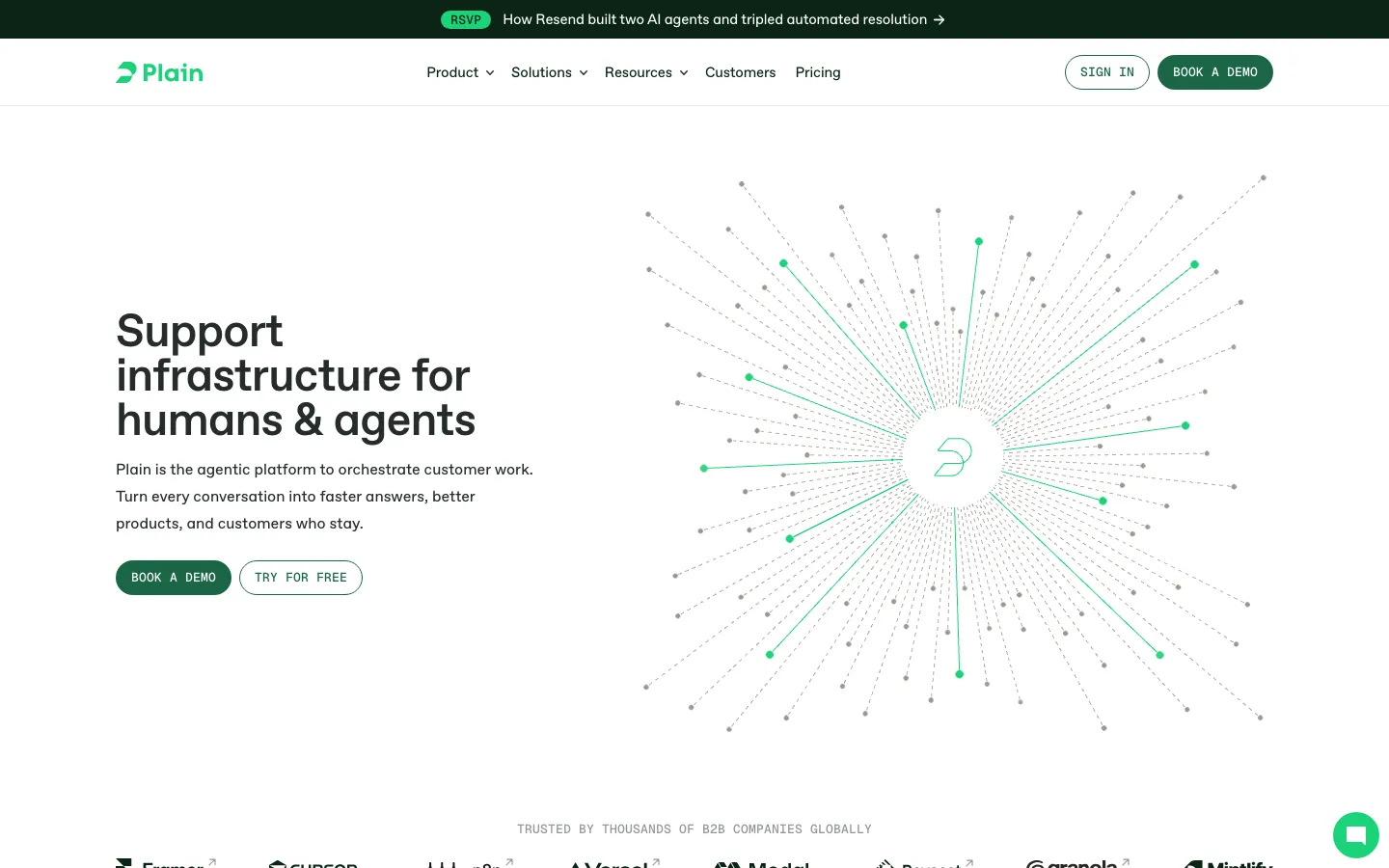
Plain resolves support friction when conversations take place in Slack while issue tracking lives in Linear. Plain puts Slack, email, in-app forms and live chat in one support workspace, then attaches customer cards, thread history and connected operational tools to the conversation. It is a deliberately B2B shape of help desk, not a broad consumer-service suite.
That focus makes Plain an unusual entry in a marketing tools directory: it is meant for product-facing support rather than a sprawling collection of channels. The $45 Foundation plan includes two email addresses, one knowledge base, 25 Slack channels and 1,000 credits each month. If your team needs broader operational controls, the price jump to Horizon is substantial, but it buys features that change day-to-day handling: Teams support, formal SLAs, escalation routes and CRM connections.
Plain is worth considering when support conversations are part of product work, not a separate call-center operation. Its strongest argument is that the same workspace can serve the person replying to a customer and the engineer investigating the cause.
Who is Plain best suited for in customer support?
B2B teams with shared-channel support
Route shared Slack-channel questions into one queue, preserving account context and conversation history.
Support teams with engineers nearby
Connect Linear or Jira issues to support threads while customer records remain visible.
Teams building agent workflows
Use documented API and MCP access with Connected Agents and shared customer context.
Growing support operations
Upgrade to Horizon when additional channels, SLAs, escalation paths and CRM connections become requirements.
I would not choose Plain just to get a cheap general inbox. Foundation is constrained by design: five member seats, two email addresses, one business-hours schedule and seven days of reporting history. It works when those boundaries match a compact B2B team. A larger operation should price Horizon early, rather than treat it as an upgrade to postpone.
Which ticketing and developer features does Plain include?
A consolidated B2B queue
Plain handles shared Slack channels, email, in-app forms and live chat in the same workspace. Plain also supports Microsoft Teams and Discord, while Horizon specifically lists Microsoft Teams. The account view includes customer cards and thread history, while integrations can create and link Linear or Jira issues from a thread. That removes the handoff where support copies a customer problem into an engineering system and loses the surrounding conversation.
Customer Agent and Sidekick Agent
Customer Agent is Plain's customer-facing AI agent. You set its tone, rules and assignments, point it to a help center or internal documents, and can use Test Mode on live traffic before it sends replies. Plain says each answer links to the source it used. Sidekick is the internal agent: its credit use ranges from 15 to 300 or more credits depending on effort. This split is useful because drafting a response and investigating a difficult thread are different jobs.
Connected Agents and automation
Connected Agents let a team bring its own agent into Plain. The pricing grid lists unlimited workflows on every plan. It also lists automatic labeling, urgency detection, thread summaries and suggested responses, but does not specify their plan availability. Plain charges Connected Agents 15 credits for an assignment plus another 15 for a discussion; Customer Agent draws 100 credits whenever it resolves an issue. Those units make Plain flexible, but they also mean the headline seat price cannot tell you the whole cost of an AI-heavy support operation.
Channels, broadcasts and context
Plain lists Slack Broadcasts, Discussions and Digests. Broadcasts let teams send proactive messages to Slack channels, then route replies into Plain as support threads. Every plan also includes customer cards, and the grid lists 15-second customer-card data freshness. For a B2B team that supports a known account base, that context is more valuable than another anonymous ticket counter.
API, webhooks and MCP
Plain's GraphQL documentation says the product itself is built on the same API exposed to customers, and it documents API keys, OAuth, webhooks, events and an MCP server. Plain's pricing page lists those developer capabilities, but does not specify which plan includes each one. Confirm plan eligibility if your support agent or internal system needs to read and act on threads, then set permissions carefully because the API can access the same workspace model as the user interface.
How is Plain priced across user tiers?
Price checked 27 Nov 2026
| Plan detail | Foundation$45/user/mo | Horizon$99/user/mo | FrontierCustom |
|---|---|---|---|
| Billing shown | Annual | Annual | Annual |
| Member seats | Up to 5 | 3 to 10 | Custom |
| Viewer seats | Unlimited | Unlimited | Unlimited |
| Monthly included credits | 1,000 | 2,500 | Custom |
| Slack channels | 25 | Unlimited | Unlimited |
| Email addresses | 2 | 10 | 25 |
| Microsoft Teams | Not specified | ✓ | Not specified |
| SLAs and escalation paths | Not specified | ✓ | Not specified |
| SSO and SCIM | Not specified | Not specified | ✓ |
Plain prices in US dollars, 27 Nov 2026.Plain pricing
The first real team bill is straightforward. On the 27 Nov 2026 pricing, three Horizon members cost $297 per month equivalent, or $3,564 billed annually, before additional usage credits. The plan includes 2,500 monthly credits. A three-person team considering Horizon should compare that bill with the operational features Horizon lists: Microsoft Teams support, formal SLAs, escalation routes and CRM connections.
Credits are the variable part. Plain sells 1,000 additional credits for $10, 2,000 for $20, 5,000 for $50 and 10,000 for $100. Customer Agent uses 100 credits per resolution. One hundred Customer Agent resolutions consume 10,000 credits. Foundation's 1,000 included credits cover 10 resolutions, leaving 9,000 credits, or $90, before any Sidekick or Connected Agent use. Track actual credit patterns during the seven-day trial before assuming the included allowance is enough.
What governance features are provided in Plain Frontier?
Plain Frontier provides large organizations with a custom-priced annual plan centered on strict enterprise governance. It provides tailored credit allowances, multiple workspaces, custom contracts, advanced security, SSO and SCIM, HIPAA, guided onboarding and a dedicated customer success manager. The published table does not give a price, so it is a conversation for a team with those compliance or organizational requirements already defined.
Where does Plain reveal operational limitations?
Plain enforces tier boundaries earlier than its polished interface might suggest. Foundation has a five-member ceiling, two email addresses and 25 Slack channels. Reporting history is seven days, while Horizon and Frontier keep it for all time. If your operating review depends on month-over-month themes, the entry plan is not the right financial comparison.
The AI model is transparent but not flat-rate. Customer Agent, Sidekick and Connected Agents each consume credits differently. That is fairer than hiding automation inside a vague “AI included” promise, yet it also asks you to forecast work that may be irregular. Take the trial with representative threads, not only straightforward questions, then decide which agent tasks genuinely reduce human work.
Finally, Plain's strength is also its limit. It is built around B2B support channels and customer context. A team with a conventional, high-volume consumer help desk may need a platform designed around a different workflow, rather than stretching Plain past the use case its plans describe.
What are the leading alternatives to Plain?
For another B2B support configuration, read the  Pylon review alongside Plain's seat, channel and credit limits. Pylon prices seats plus agentic credits rather than tickets, so it is useful when you want ticket volume to stay out of the pricing equation.
The  Re:amaze review is useful when inbox capacity is the pressure: its Basic plan lists unlimited email inboxes and live chat. Use both reviews to decide whether Plain's Slack-centered operating model matches the conversations you actually receive.
What is the final verdict on using Plain for support?
Plain earns its place with B2B teams whose support threads contain real product work. Foundation is a credible starting plan at $45 per member a month on annual billing when Slack, email and in-app support are enough. Horizon is the honest entry point for teams that need Teams, formal service levels, escalation paths or CRM synchronization, so budget for that version instead of letting the cheaper plan set the expectation.
Run the seven-day trial with a representative shared Slack channel, test Customer Agent in Test Mode, and log the credits used by real resolution patterns. Choose Foundation only if its seat, channel and reporting limits fit your current support operation.
How was this Plain support review verified?
Plain pricing, documentation and developer capabilities were reviewed against vendor pages on 27 Nov 2026. Prices are in US dollars, as Plain shows them, and every figure follows the rules in how we check figures.
- Plain pricing page, including seats, credits and plan features
- Plain Customer Agent and integrations pages
- Plain GraphQL API documentation
What are frequent questions about implementing Plain?
How much does Plain cost?
Foundation is $45 per member per month on annual billing, Horizon is $99, and Frontier is custom. Foundation includes 1,000 credits monthly and Horizon includes 2,500.
Does Plain offer a free trial?
Yes. Plain's seven-day trial does not require a credit card. Its pricing page also points startups to a 50% discount program.
What uses Plain credits?
Each Customer Agent resolution draws 100 credits. Sidekick draws from 15 credits to 300 or more according to effort, while Connected Agents require 15 credits for an assignment and another 15 for a discussion.
Does Plain work with AI agents?
Yes. Plain documents a GraphQL API, webhooks, events and an MCP server, and its pricing grid lists Connected Agents on all three plans.
 Reviewed byDanny Kirk
Founder of ReddiReach.
 Checked byAndrés Felipe
Digital designer and marketer.
Every figure is checked against the vendor's own page. Read our editorial standards.